VCU Faculty Mentoring Program
VCU’s Faculty Mentoring Program, initially launched in 2025-26, is designed to support faculty success and professional growth using a mentoring model that balances individualized guidance with cohort and peer mentoring activities. Through regular 1:1 mentoring and unified cohort sessions, participants receive comprehensive support in teaching, research and scholarship, and navigating the academic landscape to further their success.
Program Structure
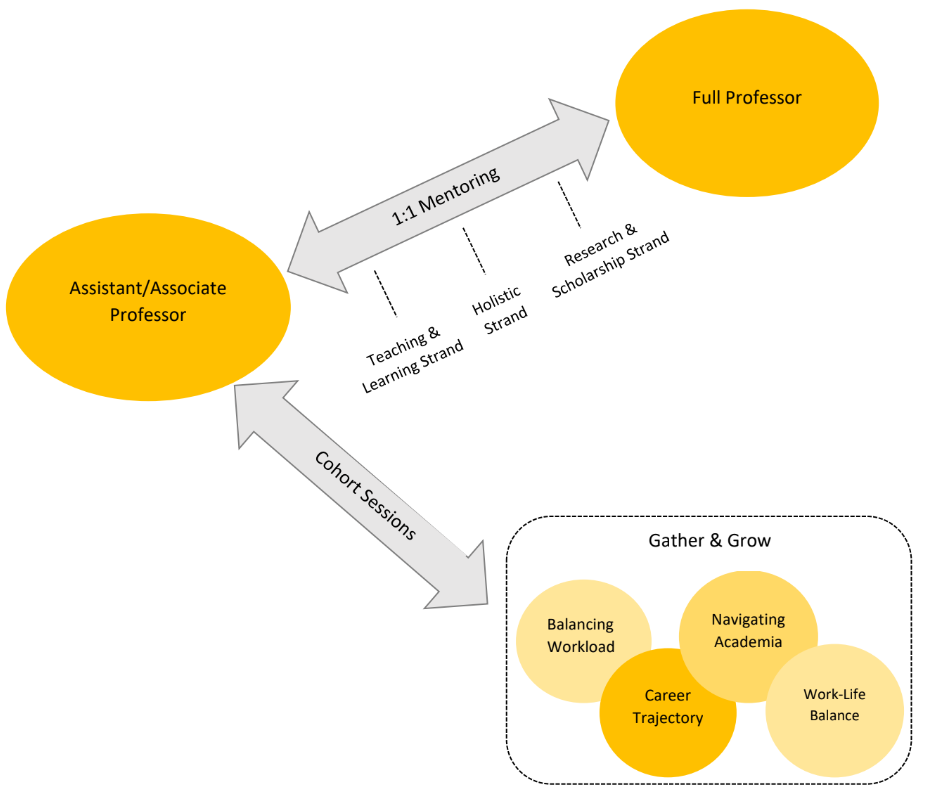
1:1 Mentorship
Assistant and associate professors have the opportunity to be matched with full professors who serve as dedicated mentors. Matches are carefully coordinated by Faculty Affairs staff. Matches are made outside home departments, schools or colleges to broaden institutional perspectives and encourage unbiased guidance. Each mentor receives training and support from Faculty Affairs and works with up to two mentees.
Faculty Mentors
Mentors
Christopher Brooks, Anthropology, College of Humanities & Sciences
Sarah Jane Brubaker, L. Douglas Wilder School of Government and Public Affairs
Kendall Buster, Sculpture & Extended Media, School of the Arts
Michael Cabral, Electrical & Computer Engineering, College of Engineering
Elizabeth (Liz) Canfield, Gender, Sexuality and Women’s Studies, College of Humanities & Sciences
Haley Cleary, L. Douglas Wilder School of Government and Public Affairs
Abigail Conley, Counselling and Special Education, School of Education
Amy Cook, L. Douglas Wilder School of Government and Public Affairs
Krista Donohoe, Geriatric Pharmacotherapy, School of Pharmacy
Stephen Fong, Chemical & Life Science Engineering, College of Engineering
Parthasarathy Madurantakam, General Practice/Dental Research, School of Dentistry
Jason Merrick, Supply Chain Management & Analytics, School of Business
Karla Mossi, Mechanical & Nuclear Engineering, College of Engineering
Tamer Nadeem, Computer Science, College of Engineering
Carmen Rodriguez Hernandez, Life Sciences and Sustainability, College of Humanities & Sciences
Sarah Seashols-Williams, Forensic Science, College of Humanities & Sciences
Jeff Shockley, Supply Chain Management and Analytics, School of Business
Fernando Tenjo, Biology, College of Humanities & Sciences
Faika Zanjani, Gerontology, College of Health Professions
Emily Zimmerman, Epidemiology, School of Public Health
Knowledge Group Faculty
Jose Cortina, Management & Entrepreneurship, School of Business
Leslie Cloud, Neurology, School of Medicine
Charlene Crawley, Chemistry, College of Humanities & Sciences
David Downs, Finance, Insurance & Real Estate, School of Business
Ramana Feeser, Emergence Medicine, School of Medicine
Amol Karmarkar, Physical Medicine & Rehabilitation, School of Medicine
Suzanne Mazzeo, Psychology, College of Humanities & Sciences
Maria Rivera, Biology, College of Humanities & Sciences
Semi Ryu, Kinetic Imaging, School of the Arts
Mentoring Focus
Mentees can choose to focus on a specific strand, or area, of their faculty responsibilities throughout the program. The strand topics will be the focus of 1:1 mentoring sessions and aspects of the “gather and grow” cohort sessions.
The strands include:
- Teaching and Learning Strand: Focused on teaching and impact on students. Where mentees may receive advice on student engagement, curricular innovation, and the scholarship of teaching and learning depending on their individual needs and interests.
- Research and Scholarship Strand: Focused on research, scholarly and creative expression activities. Mentees may receive guidance on elevating their scholarly profile, finding collaborators, navigating writing and publishing workflows, and securing funding or grant.
- Holistic Strand: Focused on the broad responsibilities of faculty and includes guidance and support to enhance teaching and learning efforts as well as research and scholarly activities.
Gather & Grow: Cohort Sessions
Connect with your cohort through meaningful group sessions. These sessions address topics and strategies to guide how you can navigate academia and the institutional environment effectively. Topics include general career growth and specific issues including: balancing workloads, managing academic expectations, developing career trajectories and maintaining work-life balance. Cohort sessions involve large and small group activities, where you can connect with faculty with similar career stages and responsibilities.
Program Benefits
The program is intended to offer the following benefits to the mentees:
- Candid conversations providing trusted, one-to-one advice from senior faculty
- Shared experiences and collective problem-solving through unified topical sessions
- Clear direction for developing a career plan
- Guidance to navigate academia
- Facilitate retention and increased productivity
- Opportunities to build interdisciplinary connections across different schools and campuses
Expectations
- Meet with your mentor at least twice a semester
- Ensure timely communication with your mentor
- Prepare for 1:1 mentor meetings by identifying meeting goals
- Attend program events for mentors and mentees - fall kick-off session & spring end-of-program session
- Attend and participate in the cohort gather and grow sessions to expand your faculty network and explore strategies for navigating academia and your own career advancement
- Share your experience and professional successes with Faculty Affairs
- Complete program assessments to identify areas for program growth, improvement and effectiveness
- Serve as a mentor for two faculty mentees at the assistant and/or associate level
- Meet with each mentee at least twice a semester
- Attend program events - kick-off session for mentors and mentees; mid-year check-in meeting; end-of-program session
- Communicate any concerns, challenges or requests for resources with Faculty Affairs
- Be accessible in the event the a mentee has an unanticipated concern
- Complete program assessments to identify areas for program growth, improvement and effectiveness
Our Impact: By the Numbers & Faculty Voices
Mentors benefitted through supporting and helping others, learning about the culture of other units and disciplines, engaging in conversations outside of their own unit, making new connections and relationships
Proven Success
100%
would recommend to a colleague
100%
felt they had a reliable person to turn to for help
95%
received actionable advice and guidance for their career
Top ranked impacts:
understanding promotion and/or tenure requirements & developing faculty identity
What Our Participants Say
With my mentor’s guidance, I learned how to translate abstract ideas into intuitive explanations and real-world applications. My confidence in designing inclusive course materials grew, and I have become a more reflective, adaptive instructor.
My mentor guided me through the uncertainties of being a new assistant professor. They provided practical advice on navigating departmental culture, managing expectations, and prioritizing responsibilities. Their support has given me the confidence to handle challenges thoughtfully.
My mentor showed me how to build meaningful professional connections. With their encouragement, I have already submitted one internal proposal and am currently collaborating with a new group of faculty on another exciting project.
The mentoring program is thoughtful and supportive. Mentors and mentees are carefully paired and the mentors are experienced faculty at VCU who are caring and supportive.
As a mentor, it has been valuable to learn more about the specific challenges faculty face, particularly those in other units…and have found it especially useful to listen to and better understand the concerns of early-career faculty.
Being a mentor helped me see the broader landscape of the university, learn more about the varying expectations, and self-reflect even more.
Resources
Mentors: see here for resources. [You will need to log in using your VCU username and password to access.]